9th Congress: New Hampshire 1804
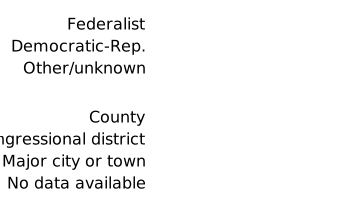
This page includes an interactive map. A text version of the same election data is available in the table below the map.
New Hampshire elected five Federalists to the Ninth Congress.
New Hampshire used a statewide at-large method for electing members to Congress.
| District | Candidate | Party | Vote | Percentage | Elected |
|---|---|---|---|---|---|
| At-large | Samuel Tenney | Federalist | 11,087 | 10.2% | ✓ Elected |
| At-large | David Hough | Federalist | 11,077 | 10.2% | ✓ Elected |
| At-large | Thomas Thompson | Federalist | 11,075 | 10.2% | ✓ Elected |
| At-large | Silas Betton | Federalist | 11,073 | 10.2% | ✓ Elected |
| At-large | Caleb Ellis | Federalist | 11,064 | 10.2% | ✓ Elected |
| At-large | Nahum Parker | Democratic-Republican | 10,636 | 9.8% | Not elected |
| At-large | Ezra Bartlett | Democratic-Republican | 10,601 | 9.8% | Not elected |
| At-large | Thomas Cogswell | Democratic-Republican | 10,599 | 9.8% | Not elected |
| At-large | Clement Storer | Democratic-Republican | 10,598 | 9.8% | Not elected |
| At-large | Jedediah K. Smith | Democratic-Republican | 10,577 | 9.8% | Not elected |
In most cases, only candidates who received more than 5 percent of the vote in a district are reported. Other candidates are reported as a group, but only if they in aggregate received more than 5 percent of the vote. In addition, percentages for each district may not add up to 100 percent due to rounding. The term Dissenting Republican includes various breakaway factions of the Democratic-Republican party.
New Nation Votes Data
Legend
Related Maps
How to Read This Map
Four steps to get started.Citation
“9th Congress: New Hampshire 1804,” Mapping Early American Elections, https://earlyamericanelections.org/maps/meae.congressional.congress09.nh.county.html